AI, Watermarks and Your Children's School Photos… We Need to Have a Little Chat!
Right, let's talk about something that's been on my mind today. And honestly, it's a bit of a minefield!
Have you ever looked at your child's school photo, seen the watermark across it and thought…
*“Oh, I could just pop this into ChatGPT and get it to remove that, couldn't I?”*
Or perhaps you've thought the photo could do with a little brightening, sharpening or a quick glow-up before you print it?
Well, before you do, can we have a little chat about what actually happens when you upload that photograph to an AI tool? Because there's quite a bit to think about, and it's not necessarily what you might expect!
First things first… whose photograph is it, anyway?
I completely understand that school photos can be an expense, especially when you've got more than one child. And yes, we all have those moments when we look at a photograph and think, *“I could have taken that myself!”*
But here's something worth knowing.
Just because a photograph features your child doesn't automatically mean you own the copyright to it.
In the UK, copyright in a photograph will generally belong to the photographer who took it, unless the rights have been transferred or a different arrangement applies. Buying a print or digital image usually gives you the photograph to keep and use under the agreed terms, but it doesn't automatically transfer the copyright.
That watermark you can see across the image? It's there to help protect the photographer's work while you view the photographs and decide which ones you'd like to purchase.
Removing it to avoid paying for an image you're not licensed to use can raise copyright and licensing issues.
And before anyone thinks we're all sitting in a dark room rubbing our hands together and counting our millions… I promise you, we are not!!
Many school photographers are small, independent businesses. We have cameras, lenses, insurance, editing software, gallery fees, travel expenses and all the usual bills that come with running a business.
And in many cases, we don't get paid simply for turning up at a school and taking the photographs. We earn our income when parents place orders.
So those photographs aren't just a few clicks of a button. There's a whole lot of work happening behind the scenes, and those sales help keep our businesses going.
Now, the bit about AI that really got me thinking…
Let's say you upload that watermarked photograph of your child to ChatGPT or Claude and ask it to remove the watermark or enhance the image.
What actually happens?
When you upload a photograph to an online AI service, you're sending it to that service so it can analyse the image and respond to your request. Depending on the tool, the image may be processed on the provider's servers rather than entirely on your own device.
The AI can analyse the image, identify visual patterns and generate an edited version based on your instructions. It might attempt to remove the watermark, reconstruct the areas underneath it, sharpen details or even change aspects of your child's appearance.
Pretty clever, isn't it?
But here's the important part: AI services have different rules about how uploaded images and conversations are processed, stored and potentially used to improve their models.
For example, some services may retain content for a period of time. Depending on the provider, your account, your settings and the circumstances, submitted content may also be eligible for use in model improvement. Other settings and plans offer different protections.
Turning off model training, where that option is available, doesn't necessarily mean an image is never uploaded or temporarily retained.
And that's why it's worth checking the privacy settings and terms of the particular service you're using before uploading photographs of your children.
I'm not suggesting that every image uploaded to AI is going to end up somewhere it shouldn't. That simply wouldn't be fair or accurate.
But I do think we should pause for a moment and ask ourselves whether we understand what we're sharing, where it's being processed and how the service handles it.
After all, our children can't always make those decisions for themselves, can they?
A little bit of caution goes a long way when it comes to photographs of our little people.
And if you're unsure, the simplest option is to contact your photographer. We're generally a friendly bunch, and we're much happier answering a question than discovering our work has been altered and reused without permission!
But hang on… isn't AI amazing?
Oh, absolutely! And this is where things get a little complicated, because photographers are being pulled in both directions.
We want our images to look beautiful. Parents want their children to look their best. And let's be honest, most of us have used a filter at some point in our lives!
But there's a difference between a little tidy-up and completely changing someone's appearance.
Photography has evolved enormously over the last five years, let alone since the days of film cameras, darkrooms and manually developing prints. The technology available to us now is incredible, and AI has changed the industry in a big way.
Many photographers, including those working in newborn, family, portrait and school photography, use editing software such as Evoto.
And honestly? It's mind-blowing!
AI-powered editing can smooth skin, reduce blemishes, tidy stray hairs, soften the appearance of dark circles, remove reflections from glasses and even reshape facial features or bodies.
Some tools can alter hair colour, adjust facial proportions and make significant changes to someone's appearance in seconds.
It's clever stuff, and when used carefully, it can be a real game changer.
For photographers working through hundreds of images, the time saved can be enormous. That means a more efficient workflow, greater productivity and, hopefully, more time to focus on the bits of photography we really love.
But just because we can change something with AI doesn't necessarily mean we should.
There is a difference between enhancing a photograph and changing someone's appearance so dramatically that they no longer look like themselves.
And when we're photographing children, I think that distinction matters enormously.
So, how safe are the editing tools photographers use?
This is where we need to separate one type of AI from another.
Not all editing software works in the same way. Some tools can process images directly on your computer, while others send images or image data to remote servers to perform certain AI-powered operations. Some use a combination of both.
Evoto, for example, offers local project workflows, but some features can rely on cloud processing. So, even if a project is saved on a photographer's own computer, that doesn't necessarily mean every single editing operation happens there.
And using AI doesn't automatically mean photographs are published online, shared publicly or used to train an AI model. These are separate things, governed by the software's features, settings and policies.
As photographers, we need to understand the tools we're using, especially when handling photographs of children.
We should know where images are processed, how they're stored, who may have access to them and what happens to them afterwards.
We shouldn't promise that photographs never leave our computers unless we know that is genuinely the case.
It's not the most glamorous part of photography, I know. Nobody gets into this job because they dream of reading software privacy policies with a cup of tea!
But it's part of being responsible with the trust parents place in us.
And then there's school photography…
School photography has another little twist in this whole AI conversation.
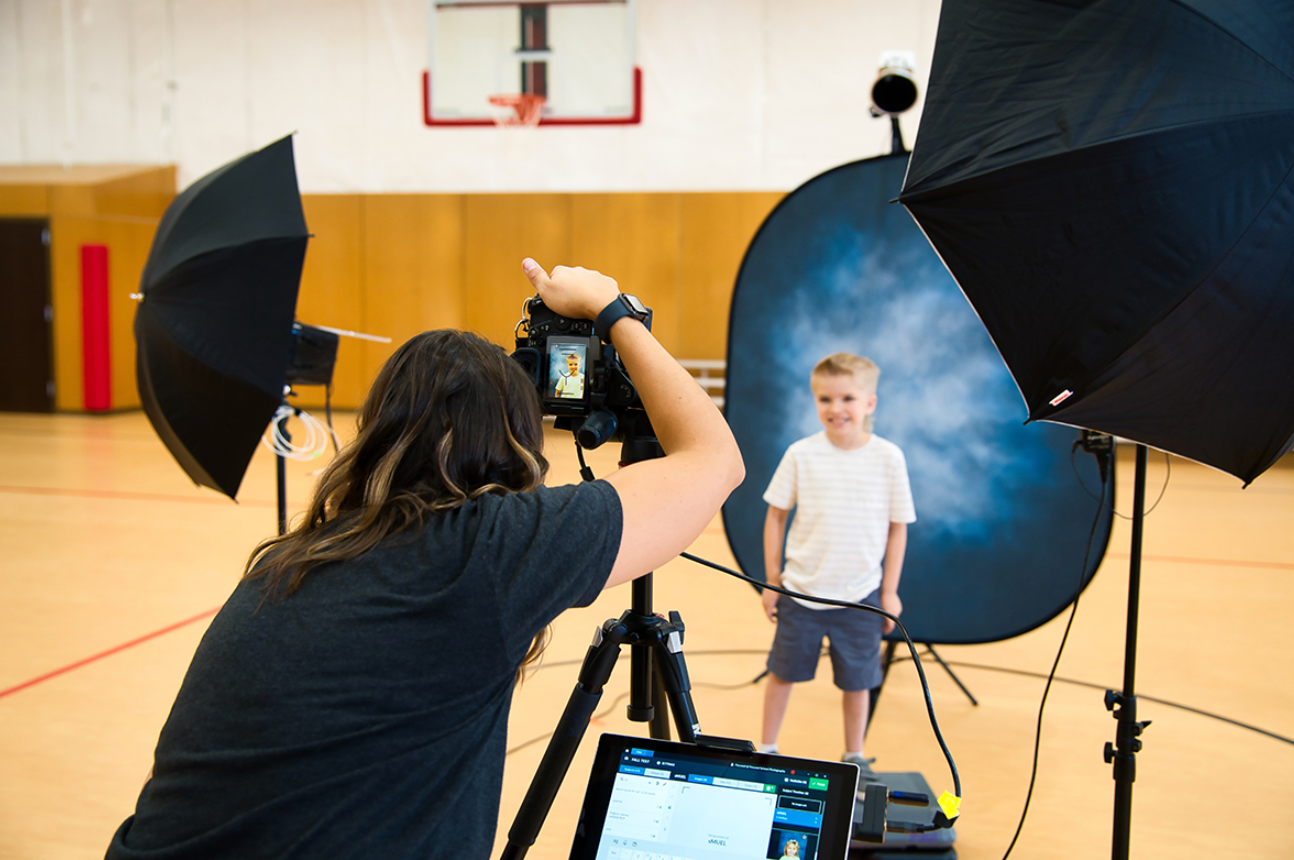
Many of us use specialist online portals to manage our galleries, process orders and provide parents with secure access to their children's photographs.
These systems can be brilliant. When you're dealing with hundreds of pupils, they make it much easier to organise images, manage orders and allow parents to view their child's photographs using secure access details.
Without systems like these, the admin alone could send us all running for the hills!
However, some platforms have started incorporating AI enhancement features, too.
And we've recently seen just how badly things can go wrong when those features are applied inappropriately to school portraits.
In a widely discussed incident, a batch of school photographs was reportedly processed with an AI enhancement setting left switched on, resulting in children looking noticeably different from their original photographs.
It highlights something important: AI doesn't always just remove a blemish or soften a shadow. Depending on the tool and its settings, it can alter facial details and produce an image that no longer accurately represents the child who was photographed.
Imagine sending your child's school photo to be processed and receiving an image where they barely look like themselves!
That's not what parents expect, and it's certainly not what school photography should be about.
Mistakes happen. Technology can be complicated, and settings can be overlooked. But that doesn't mean the consequences aren't serious.
Photographers need to check their settings, platforms need to make their tools clear and safe to use, and all of us need to remember that these are real children, not just files passing through a computer.
So, are photographers against AI?
Not at all!
AI is a tool, and like any tool, it can be used brilliantly or badly.
Used responsibly, it can save time, improve consistency and help photographers deliver beautiful images. Used without proper care, it can change faces, create unrealistic results and raise some very genuine questions about privacy and trust.
We're also dealing with a bit of a double standard sometimes, aren't we?
Clients may ask for flawless skin, perfectly smooth hair, brighter eyes and a little reshaping here and there. They love the results, and we work hard to give them images they're delighted with.
Yet when AI is involved in editing photographs of children, suddenly the conversation becomes much more heated.
There are perfectly valid concerns about how far editing should go, particularly with children. But the conversation needs to be about responsible use, transparency and the actual results, rather than assuming that all AI editing is automatically bad.
As photographers, we need to use our judgement, understand the technology and know when to stop.
Because a beautiful photograph should still look like the person standing in front of our camera.
A little favour from me to you ❤️
If you've made it this far, thank you!
I'm not here to tell parents off, make anyone feel guilty or suggest that every use of AI is dangerous. We all use technology in different ways, and it's changing faster than most of us can keep up with.
I'm simply asking for a little understanding on both sides.
If you see your child's school photograph and would like to purchase it, please support the photographer who created it. If you have concerns about the image, get in touch and have a conversation. If you're thinking about uploading it to an AI tool, take a moment to check how that service handles your images.
And to my fellow photographers, let's keep talking about this. Let's check our settings, understand the platforms we use and make sure we're putting the children in our photographs first.
Technology will keep evolving. AI will get cleverer, editing will get faster and we'll probably have another ten things to worry about by next Tuesday!
But some things should never change.
Respect the work behind the photograph. Protect children's privacy. Use AI responsibly. And remember that the little face in that picture belongs to a real person, not an editing experiment.
Because at the end of the day, school photographs aren't just pictures.
They're memories of our children at a particular moment in their lives. The missing front teeth, the slightly wonky fringe, the cheeky grin and that little face that seems to change every five minutes.
And those memories are worth getting right.
Love Jane xx